

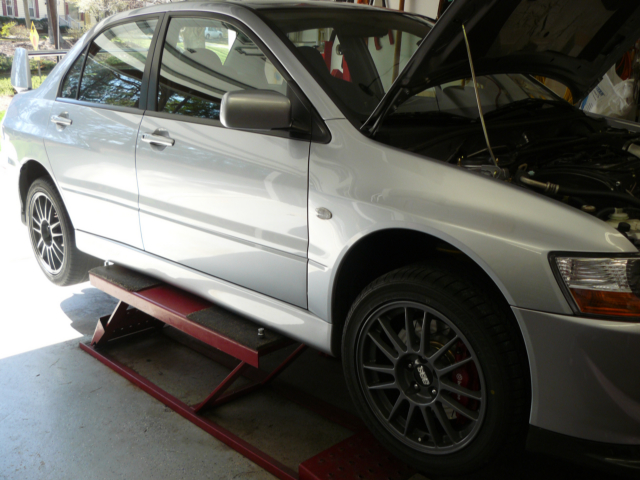
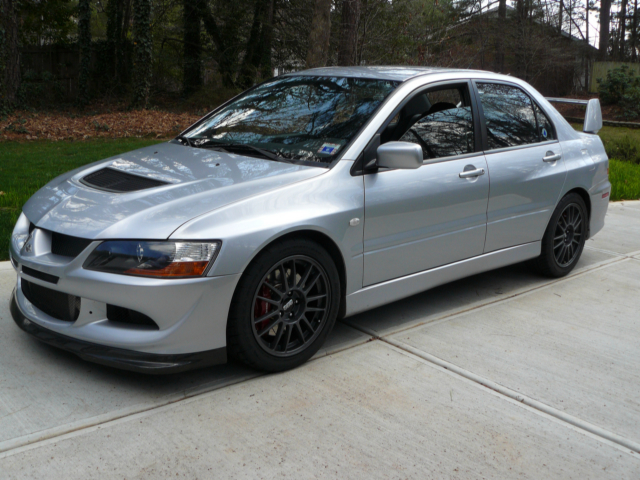
This time the project is my personal car. It is a 2005 Mitsubishi Lancer Evolution VIII MR. It is a long moniker that I usually just shorten to Evo or MR.
This is a car I truly have enjoyed. The fact that it is an MR edition means that it has a few extras over the GSR (or standard) model of the Evolution. First, it is limited in numbers. Only 850 MR versions were made in 2005. It comes with a six speed instead of the five gears on the GSR. It has some nice extras on the inside consisting of a gauge set and some nice aluminum pedals. There is some carbon fiber bling such as the parking brake handle. The MR came with a unique Bilstein suspension that provides a great ride and yet exceptional cornering. It also has a vortex generator on the back edge of the roof to enhance the downforce created by the rear wing. The roof is aluminum so no sunroof is allowed on an MR.
While it is a fantastic car out of the box there are always things that could be improved. I had already replaced the rear anti-roll bar with an adjustable unit. I bought the Mitsubishi rear strut tower brace (the front comes with a brace) and added a trunk bar that came on the RS version of the Evolution. Then I replaced the lower front suspension braces with a more triangulated unit.
This was good enough to go through three sets of Yokahama Advan tires, but I wanted a bit more. So this week we installed a set of springs that would change the stance of the car and provide some additional stiffness. They are from a company called Swift Springs and are very light weight using a proprietary alloy that results in a smaller diameter spring wire. This means more suspension travel before spring bind and lower unsprung weight.
These springs lowered the car a little more than an inch in the front and just less than an inch in the rear. Generally lowering a car means that the center of gravity is lowered producing a “good” effect. Unfortunately lowering the car changes the geometry of the suspension linkage and can result in more understeer because the roll center has been lowered as well.
To counter this problem we used a kit engineered and sold by Whiteline of Australia. It consists of replacement tie rod ends and control arm ball joints that return the geometry to angles that will keep the roll center up where it belongs. Whiteline also makes a kit to eliminate the bumpsteer caused by the geometry of the rear control arms.
The first order of business was to remove the wheels and get the car in the air. Fortunately Jim’s Garage has a lift that safely gets the car up to a decent working height. Then we emptied the trunk of the few items that were in it and removed the trim panels so we could gain access to the rear strut bolts.

With that done we moved to the front of the car and swapped out the tie rod ends. It is nice to work on a relatively new car that has not been exposed to the ravages of snowy, salted roads. The ends were easy to unbolt and drive out of the steering knuckles. The jam nut was loosened and white out was used to mark the position of the original tie rod end so that the Whiteline replacement would be set to that same position. The car would still require an alignment, but this would get it somewhat close. The old end unscrews and the new one screws on in its place. The jam nut is tightened and the end is bolted to the steering knuckle.

The control arm ball joint replacement was a much more involved process. Mitsubishi designs it so that if the original ball joint needs to be replaced, the whole control arm assembly is replaced. This is a forged aluminum unit that would not be cheap to replace. We had to press out the original ball joint, but because it was made to be part of the assembly we had to remove the aluminum that was peened over the back side of the joint. Then we used a press to push the ball joint out of the arm. A press was also needed to install the new ball joint. One critical step was to make sure that the indentation on the ball joint was facing the right way. This is to ensure that the cross bolt that holds it to the steering knuckle can lock in the ball joint.

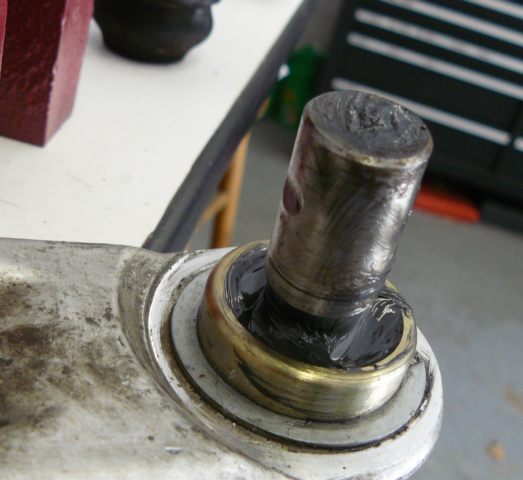

Before the yellow boot is pressed on the new ball joint, additional grease was added to the ball joint. Then the assembly was reinstalled in the car. The bolts holding the arm to the chassis require about 130 lb/ft of torque so be certain you don’t just hold an air gun to them.
In the rear we added the bump steer kit by Whiteline. This changes the pivot point on the rear track arm so that when the rear deflects as it crosses a bump it doesn’t pull the wheel inward and, in effect, steer the car from the rear.
Next to tackle were the springs. We started with the front springs by loosening and removing the two large strut bolts. Be sure to note that the top bolt has special flats on it so that you can swap it around to change the camber setting. With that disconnected we removed the three nuts on the top of the assembly from the engine compartment.
We then needed to compress the springs so that we could take everything apart. We have used various types of spring compressors over the years but we think we have found one that we really like for its simplicity and safety. It is a floor stand unit that uses a hydraulic ram to compress with. It has nice hooks that adjust to the angle of the springs as it compresses them.
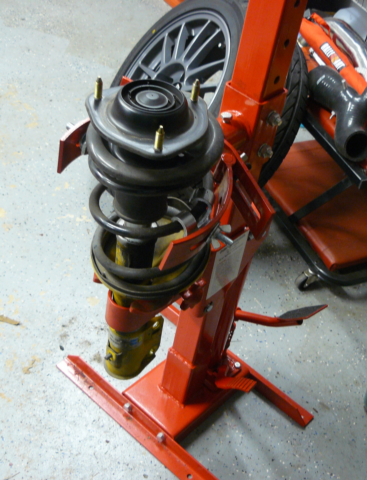
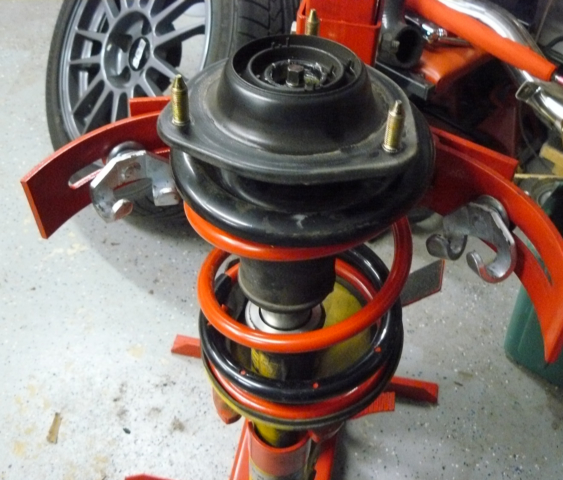
With this it was easy to swap springs and then get the assemblies back together. The front bump stops needed to be trimmed by one hump while the rear bump stops stayed whole.
It was pretty exciting to get the strut assemblies back together with the new springs and then installed in the car. The next step was to get everything aligned.
While we don’t have our own alignment rack we are fortunate to be close to a shop that is not biased against modified cars. Some shops have had problems with cars that have been poorly modified and then safety issues crop up. This shop won’t let unsafe modifications on to its rack, but will accommodate properly done suspension changes.
I had the rear toe and camber set as well as the front. That allowed me to drive off feeling confident that I would not be trashing my relatively new tires.
The results? I like the change. The car has good road manners. It is firmer, but not at all harsh. I have no problems with scraping while entering a driveway. Cornering feels flat and very predictable. Some track time will confirm these initial positive reactions.


 JIM'S GARAGE
Leave a comment