


Just off a country road and tucked into the woods north of Durham, North Carolina, the spirit of the deHavilland Mosquito has been rekindled. This time it will be taking to the roads and not the skies.
Prior to the Battle of Britton deHavilland broke with the technology trend of metal airframes of mono wing war birds and designed the Mosquito as a laminated ply and balsa skin formed in concrete molds. What resulted was a multi-role war bird that out performed just about every fighter in the sky. Light and fast it was originally configured as a bomber that was found to be able to carry twice the bomb payload it had been designed for. Its twin supercharged Merlin engines allowed one variant to have a top speed of 425 miles per hour.
This car, known as the Splinter, will also employ twin superchargers along with air to water intercoolers on a GM Northstar block. This V8 engine was chosen partly for it aluminum construction and the fact that the head bolts were symmetrical and would allow for the exhaust ports to be on the top side of the block and therefore keep the heat high and in the open where it could be exited more easily than if the headers were tucked in between the block and the rear wheel wells.
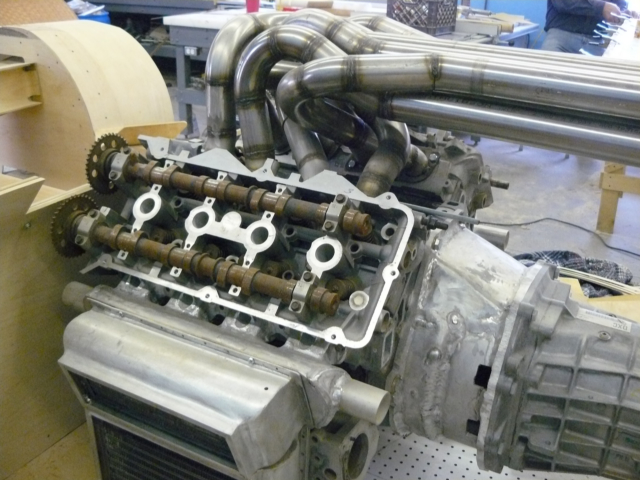
A custom bell housing was constructed out of aluminum so that the engine could be connected to a C5 Corvette transaxle. The six speed transmission will easily be able to handle the horsepower generated by the engine, which should be at least 600.

The Splinter is a dream car. It has been Joe Harmon’s dream and it is coming to life. A graduate student of NC State, Joe and a team of like minded students are creating a spectacular piece of automotive engineering that rivals anything that Chip Foose ever created.
The central tunnel is the backbone of the vehicle and it is an astounding piece of craftsmanship. Sighting down the tunnel you can see the many components that make it up and it is a thing of beauty. It consists of laminated outer shell of the tunnel along with inner channels that were laminated and molded in place after the tunnel itself was created. Then, attached to all that is the front suspension tower, upper control arm mounts, and lower control arm mounts. Tunnel ribs are added to the inside to ensure the cornering loads from the suspension are supported by the structure.

As a young boy I would often go down to the boat shop in Crosby Town and watch the workmen craft sailboats out of wood. The ribs that supported the boards that made up the hull, each one shaped to fit the compound curves and tapered to fit with its neighbor. Planks removed from the steam box and bent in an artful curve to form the cabin of a Wianno Senior. Mahogany and teak and oak and ash were wood that I became familiar with as it was used for each area of the boat that it was most suited for.
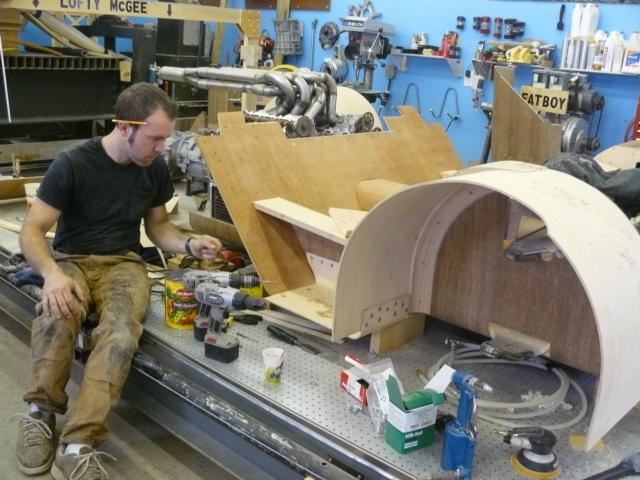
These memories returned as I watched the craftsmanship that taking place in the shop where the Splinter is taking shape. Here they were using the latest epoxies and creating wonderfully artful compound curves of laminated wood that is far stronger and lighter than aluminum or steel.
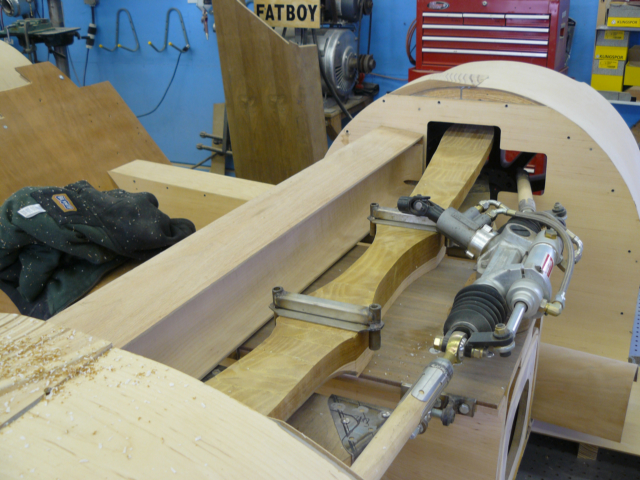
Even the springs of the suspension is made of wood. Recognizing that a mono-leaf suspension is rather like an English Longbow the team researched what species of wood would provide the strength and elastic memory required of a suspension spring. Osage Orange (a.k.a., Hedge Apple) was found to be the strongest wood in North America its properties prized by manufacturers of long bows. Considered a nuisance wood, it was not particularly easy to find and as a result they had to travel to Kentucky to obtain some logs. It took several logs to make veneer that wasn’t fraught with knots and could be laminated into the spring they constructed.
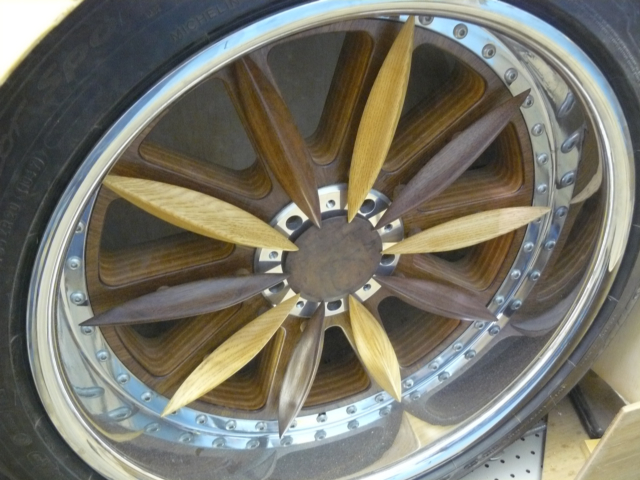
Everywhere possible wood is being used in the construction, even the wheels. They are of a three piece construction where the forged rim is bolted to a wood laminate center section.
The exhaust system is metal, of course and one of their innovations is to use the rear wing as the muffler. It provides a very large surface area with which to dissipate the heat a supercharged engine generates as well as serve double duty as an aerodynamic aid.
The central tunnel not only provides structural support, it will funnel cooling air back to the engine compartment aiding the movement of heat out of that area.
The wheel wells do more than just contain the tires; they are another structural element of the Splinter. Formed out of laminated oak veneer they are simple, light, and very strong.
The body includes a roll bar fashioned out of laminate and plywood forming a truss system. The engine compartment covers will open like butterfly wings made from beautiful compound curved balsa and veneer laminates.
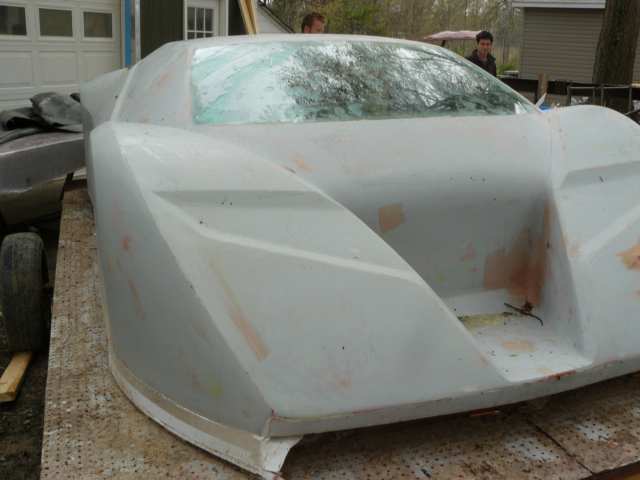
By August the Splinter should be a “roller” at the very least and after completing several show dates, it should be able to get some road time under its tires.
Despite all the jokes about termites, a wood burning engine, and the like this creation should be recognized as the astounding piece of engineering that it really is. Take a look at the Joe Harmon Design web site for yourself and be amazed.


 JIM'S GARAGE
Leave a comment