

The first consideration is that this car’s platform is body-on-frame. It’s an old structural concept that provides a very strong and ridged base for handling improvements. It has been replaced by what is called unibody. The Ford CVPI has a hydro-formed frame to which the body and suspension/drivetrain is attached. This provides a base structure that is kept at the lowest point of the vehicle and tends to therefore have a somewhat low center of gravity as the mass of the frame is topped by the body. Unibody cars were to provide advantages in terms of weight and provide control crumple zones for when collisions occur. Crumple zones were designed to sacrifice themselves in order to absorb energy from a collision prior to that energy impacting the passenger compartment itself. While the first unibody cars were definitely lower in weight than body-on-frame; as government regulations have demanded more survivability in cars, the weight differential has disappeared.

The advantage of the Ford CVPI’s body-on-frame over unibody is that when modifications are made to improve handling characteristics they have a robust frame to connect to and support the increased forces that they must deal with. When making similar modifications to a unibody chassis, often additional bracing and reinforcement at connection points must be included such as strut braces and bracing between lower suspension points. Remember that the unibody design incorporates “crumple zones” in order to sacrifice structure in order to absorb energy in a collision before it intrudes into the drive/passenger compartment and these areas are purposely weaker.
The second consideration is the tires used. Tires are critical to a vehicle’s handling personality. It is the cars only connection to the road surface so its coefficient of friction, how it handles weight transfer, and changes in road surface temperature; are important factors to consider when choosing the best tire option.
For the Ford CVPI I chose Firestone Firehawk 500 tires. The tire technology that goes into their design and construction is the best option for this vehicle. Firestone is owned by Bridgestone, the company that provided tires for Formula 1 from 1997 through 2010. Firestone has been the sole tire supplier for the IndyCar series since 2000 as well as a supplier for decades prior to that. They have a huge amount of experience in getting tire performance out of their products.
Radial tires have changed a lot of things about how tires perform and consequently what suspension construction and settings can do improve a car’s handling beyond the bias belted tire technology that once prevailed. For example, in the days before radial racing tires, camber was not a meaningful factor in chassis setup and neither was caster. Radial tires have changed that dramatically.
The Firestone tires used on the CVPI have a great deal of inherent grip and deal with rain very well. The original tires provided by Ford for their Police Interceptors was Goodyear’s Eagle RS-A. This tire’s personality ended up making the Ford CVPI tail happy. The model Firestones I chose got rid of a lot of that tendency.
The CVPIs came with a 0.80” higher ride height than the normal Crown Victoria. This was to allow the cop cars to drive over medians and curbs with less chance of damage. I picked up some Eaton springs that dropped it down a full inch from the cop car height, giving it a slightly lower stance and brought up the spring rates. The police shocks that the car came with were heavy duty versions, but KYB made nitrogen charged shocks that provided better dampening, so on they went.
The anti-roll bars that came with the CVPI package were an improvement from the standard, but they were further enhanced with a set of front and rear bars from ADTR.net. The rear bar is 1” and solid while the front bar is 1 3/8” and hollow.
The front control arms that came on the CVPI cars were stamped and welded steel. I replaced them with an optional forged aluminum set. They are stronger, more ridged and a bit lighter.
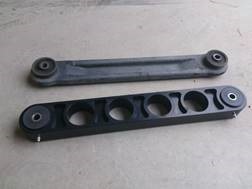
The rear control arms the car came with were also stamped steel. ADTR.net had a set of four (a pair for each side) of Heinous, upper and lower billet aluminum arms that came with polyurethane bushings with grease fittings. I would recommend the Green Grease brand because of its properties and the quality that it is waterproof.

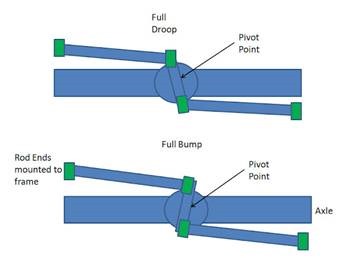
One real benefit to the CVPI is that it comes with a Watts linkage instead of the typical Panhard rod for its solid rear end.
 As shown in the simplified diagram on the left, as the suspension moves up and down a Panhard rod will move the axle side to side under the chassis.
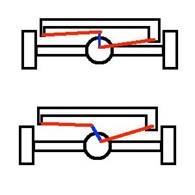
Whereas the Watts linkage keeps the rear axle in the center of the frame as the axle moves up and down.
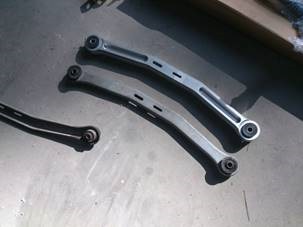
ADTR has a nice replacement for the stock stamped steel linkage arms and they too, are made of billet aluminum.

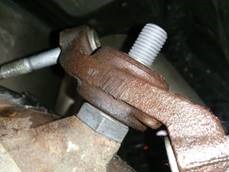
Above is the stock pivot bolt
ADTR.net also sells a pivot bolt made by ARP to replace the stock bolt with. It is much stronger and more reliable than the stock bolt.

The CVPI cars also come standard with an aluminum driveshaft. It weighs about 9-10 pounds less than the standard driveshaft giving you a better balanced and lighter driveshaft that reduces parasitic loss through the drivetrain and provides better acceleration and fuel mileage. It is more ridged and has less flex providing higher and more sustainable top speeds.
The rear axle ratio is 3.55:1 with Trac Loc. The top speed is about 130 mph.
An important aspect of getting the most out of radial tires and the car’s suspension is adjustability. The factory front end does not allow for adjustment of camber, so a SPC (Specialty Products Company) front camber adjuster kit was purchased from ADTR.net.

This allows for adjustment of the camber that occurs when lowering the car (as the Eaton springs did) as well as when adjustments are made in front caster.
With all this done it was time to focus on the alignment details. Alignments can make or break how a car works for the driver. It is part of what determines how weight transfer is handled by the all-important tires. The amount of and areas of adjustment are limited by suspension designs and what the factory engineers have allowed to be adjustable. While the rear axle of the CVPI has limited adjustability back there, the front offers a lot of options especially after the SPC camber adjustment kit is installed.

Above is a recent alignment chart for the CVPI. The rear is greyed out since it is (theoretically) non-adjustable.
One of the most important adjustments is the caster of the front suspension.

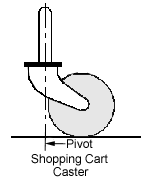
It is often ignored, but is very important to a car’s handling. We have probably all experienced a shopping cart with a bad caster and found it annoying and frustrating. On your vehicle it controls how the tires contact patch intersects with the road surface. Depending on how much the caster angle is, it will add negative camber to the cars outside wheel as the car corners and the steering wheel is turned. How much caster will also control how quickly the steering wants to return to center. As you look at the side view above you will notice the angle of the steering pivot will form a virtual ramp that works against the cars natural tendency to dive when braking. It therefore helps the car mange weight transfer in many ways resulting in better grip.
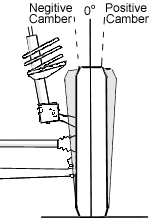
Many of us are familiar with the camber adjustment on the front wheels. Many factory settings put more camber in the rear suspension (if at all possible) than in the front in order to induce understeer as it is considered easier for most drivers to contend with than oversteer. As you can see by my alignment chart I have nearly a degree of negative camber set, while I have nearly six degrees of caster. That provides a good initial grip for the front tires going into a corner and then the caster setting adds more grip as it increases the negative camber on the outside tire in a turn. As braking occurs on corner entry the caster angle reduces the weight transfer forward as well. On exit of the corner the rear squat is controlled by the spring rate, shock valving and sway bars to a certain degree.
The factory asks for a touch of toe-out and I have retained that in order to get a quicker bite in the steering at the expense of a slight amount of inner tire wear.
How about some power?
The 2008 Police Interceptor is powered by a 4.6 liter V8 that puts out about 250 hp and 297 lb/ft of torque at the flywheel. Not bad, but also not completely thrilling. It was good for hauling around police equipment and perps in the back seat, but of course I wanted to see if I could increase the power.
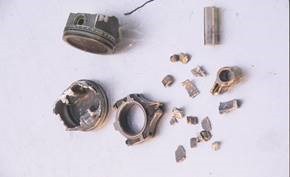
Car Craft magazine has written about what they went through trying to enhance the power of their Crown Vic project car. A supercharger was tried and provided some great power for a limited time. Then it blew up spectacularly.
The Mercury Marauder boasted a four valve modular engine and with some some tweaks put out about 307 hp.
I contacted Chris at ADTR.net and he told me about what he had done to his personal P71s. He even offers a Vortec supercharger kit that includes an intercooler. It puts out about 360 rear wheel horsepower. It was over $7000.
I looked up MMR – Modular Motorsports Racing. They build some very hot Ford modular V8 engines. A long block engine was well over $7000 and then you needed to add your supercharger.
So I could spend a lot of money on power and then had to consider what the drivetrain (transmission and differential) might also need in terms of beefing up.
OK, so I decided to do some mods that were more affordable and realistic.
ADTR.net had a nice Stainless works exhaust upgrade. It consisted of long tube headers with hi-flo catalytic converters and a stainless 2.5” system that went to the rear axle. I chose their quietest muffler and since I was having the rest of the exhaust system custom made I added large resonators after the axle. That was about $4000, installed.
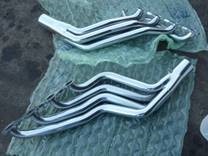


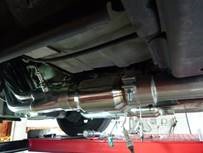
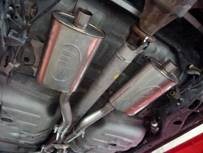

ADTR.net also had a ported and polished intake along with Steda underdrive pulleys.
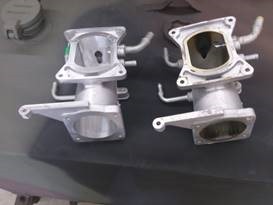
The new one on the left and the old one on the right.
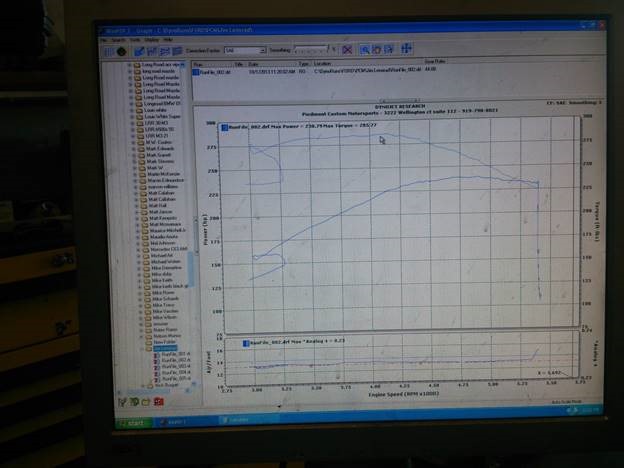
Then there was a trip to get the car dyno tuned.

The other most important step was to do the very best brake job I could. I found Centric made high carbon rotors and Hawk made a fantastic street/track pad that worked great when paired with a DOT4 brake fluid that could deal with well over 500 degree temps.
Now my CVPI is a 4000 pound sports car.


 JIM'S GARAGE
Leave a comment