

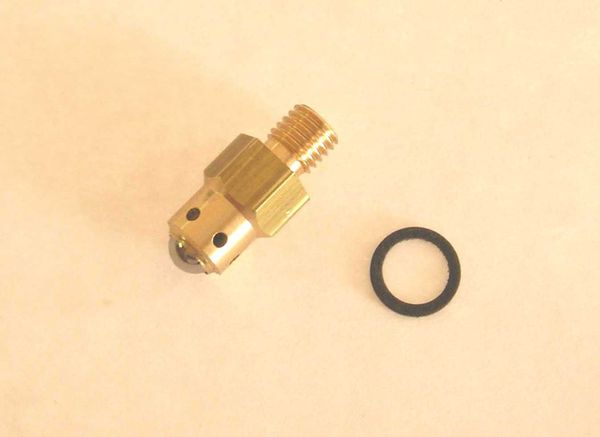
It was a classified add in the Competition Press, the newspaper that became Autoweek, that I first saw it. “2 Balls do the Trick” was the tag line. It was an inventor’s replacement for the troublesome needle and seat used in carburetors as a valve to control the fuel that filled the carburetor’s fuel bowl. The fuel bowl is like a tiny gas tank that is part of a carburetor. It provides fuel as needed rather than waiting for it to be delivered from the fuel tank. The needle and seat is opened and closed by the float in the fuel bowl. When you re-built a carburetor setting the upper and lower limits of the float was critical to smooth performance. As the fuel is sucked out of the fuel bowl the float sank and pulled the needle away from the seat allowing gasoline to flow into the bowl until the float reached the point that the needle was pushed against the seat and shut the flow off. The “needle” was shaped much like a rod with a cone on one end. The rod was usually not round. It had three or four flats so that the fuel had less resistance as it flowed past the cone end. The cone end came in contact with a seat that was angled much like the seat that an intake or exhaust valve seats against.
Over time the cone would develop a ring wear pattern where it constantly came in contact with the seat. They were usually both made of brass, but sometimes neoprene was used for the cone part to try to limit the wear pattern. Once the ring was worn into the seat, the valve never worked as it should and affected the carburetor’s performance.
Mr. Grose had the bright idea of completely re-designing the needle and seat valve. His idea was to use a ball bearing that would constantly present a new surface to the seat and therefore provide a consistent metering of fuel. A large ball was used as the surface that the float would act against while a smaller ball would come in contact with the seat.
It was a simple and elegant solution to pesky problem with carburetors. The race car world loved it.
Carburetors were complex devices that performed a very simple function. Carburetors atomized the fuel so it could be burned.
When gasoline is in its pure liquid form it doesn’t like to burn. I used to watch guys throw their cigarette buts into a pail of gasoline and put out the cigarette. DO NOT EVER DO THIS!!! It was a stupid thing to do because if there was ever enough gasoline vapor above the liquid it would have been tragic. The point is that for a gasoline engine to work well the fuel burns best when it is mixed with air. The ideal ratio is about 14 parts air to one part gasoline. This is not a constant though, which is why carburetors are so complex. The ratio must constantly change based on manifold vacuum, throttle plate position, engine temperature, and on and on.
If you want to see a simple example of how a carburetor atomizes fuel look at a spray bottle of window cleaner. As air is pushed across the top of a hollow tube a vacuum is created that pulls up the liquid and mixes it with air forming a spray mist.
One day I decided to drive up to Stoneham, near Boston, and pick up a Grose Jet. This was in the days before Mapquest or GPS so I looked up the address in the ad and found a map of the town. It was called D & G Valve Mfg. Co., Inc. on 8 Mt. Vernon Street, and I really did not know what to expect. Would it be a large brick factory with chain link fence and guard house?
It turned out to be a house in an old Stoneham neighborhood. I went to the door and knocked. A large man with a machinist apron on greeted me and invited me in to the manufacturing shop set up in the basement of his house. He wanted to know what model of carburetor I needed a gross jet for. Since I was there I picked up one for the Quadrajet on my mother’s Pontiac as well as the Holley on my VW. He took the time to show me how his jigs were set up to manufacture the different Grose Jets. For motorcycles he used glass for the larger ball to keep the mass down and deal with the vibration better.
He pulled two Grose Jets out of the drawers of his cabinets and sold me what I was looking for.
I drove home enlightened to see what a Yankee inventor could produce out of the basement of his house and become famous for in an underground sort of way.
Look up D & G Valve on the Internet, you can still find it. Amazing.




 JIM'S GARAGE
Leave a reply to John Titus Cancel reply