

In an earlier post Bullitt was one of several movies on my “Car Movies” list. It is there as not only one of the top car movies yet, but it is a model for what makes a movie appropriate for a “Car Movies” listing.
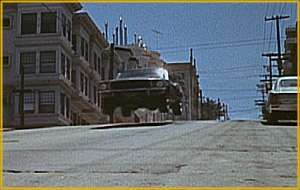
The most important characteristic of its car chase scenes is that they are believable. The director, Peter Yates, was chosen because Steve McQueen had liked his previous work, “the Robbery”, and in particular, its realism. It was the end of the sixties and the blind faith in the government of the post-WWII era had morphed into cynicism and suspicion. McQueen wanted believable amounts of reality in his films.
San Francisco was unlike Los Angeles in that it bent over backward to accommodate the movie production. To allow a car chase to be filmed where speeds would exceed 100 miles per hour on public roads was a first. It was not a trivial task to set up, rehearse, and execute the chase scenes. The editing of the chase delivers everything that it should and, as an audience, you are not distracted by the lapses in continuity.
The stars are the cars. The production used two 1968 Highland Green Mustang GT’s with 390 V8 engines, and three 1968 Dodge Charger RTs with 440 engines. While the Mustangs went through several modifications the Charger was left basically stock. With Bill Hickman driving they kept putting smaller tires on the Charger so McQueen’s Mustang could keep up.
Bill Hickman was the best stunt driver in the world at that time and also could act. Not that he had what could be called a speaking role, but his double take when Bullitt’s Mustang appears in the Charger’s rear view mirror was perfect. Hickman also had the look of a hit man, along with Paul Genge as the white haired, shotgun wielding assassin. Paul was in reality not familiar with firearms and scared to death to be in the car during the filming of the chase scenes. Word is they filled him with tranquilizers and shoved him back in the car.
Bill Hickman would later be in the movie “Seven Ups” and “French Connection”, and I remember him playing a uniformed guard in an episode of Outer Limits. Hickman was a very cool driver, just as calm as he looked in the film. He could drive a car and place it where ever you needed it and duplicate the feat as often as you needed it done.
The Mustangs were stripped of the fog lights and trim in the middle of the grill, the rocker panel were painted body color, the white “C” stripes were removed from the sides, and MUSTANG lettering was removed from the rear. McQueen added some dents and dings to make the car look believable. Max Balchowsky prepared both the Mustangs and the Chargers. He focused first on the suspension of the Mustang, He reinforced the shock towers, adding cross members (what we would call strut tower braces today), upgrading the springs for higher rate versions. You can see some shots of the Mustang with the stock springs when Bullitt is driving to his apartment at1153 Taylor Street
The stock shocks were replaced with Koni shocks and the subframe was braced considerably. The A-arms were Magnafluxed and reinforced as well. The engine’s top end also received some modifications. The heads were milled for increased compression, headers were added along with a high performance ignition and the stock carburetor was re-worked. The exhaust sound you hear in the movie is the real thing. The sound was, for the most part, recorded during filming with only a few gaps that were filled in by taking the cars to the race track and recording the sounds there. The interior was basically stock as was the shifter. Steve had the steering wheel replaced with a Carrol Shelby model and had the wood rim covered in black leather.
The Chargers had the torsion bars in the front end upgraded to a higher rate and the rear leaf springs were swapped out for police model springs that raised the spring rate without raising the ride height. The engine was left basically stock.

The third car in the chase scenes was the camera car. It was a modified Corvette with basically no body and an area behind the driver where a camera and operator sat. The driver was Pat Houstis and Bill Fraker operated the camera. Pat designed and built the camera car.
Special effects? No computer generated graphics anywhere here. When Bill Hickman’s Charger understeered into a camera as he went around a corner you see it all up until he smashed the camera. McQueen followed and understeered so badly he had to back up and take the corner again. Showing clearly that the Mustang didn’t have posi-traction. There are two notable special effects none the less. One is the breaking of the Mustang windshield by the shotgun blast from the Charger. That was accomplish by some chain balls that strike the windshield at precisely the perfect time. The other effect of the Mustang bumping the Charger off the road and into the gasoline pumps. This was done by creating a tow rig where the Mustang was hooked to the Charger until it was released at just the right moment. Almost the right moment anyway. The Charger missed the gas station, but brilliant editing and pyrotechnic work ensured that it looked as it should. The movie’s film editor received a well deserved Oscar for his work.

The nine minute, forty-two second chase sequence continues to galvanize viewers and allows teenage boys (of all ages and both sexes) to see their fantasy of racing through city streets on the big screen.


 JIM'S GARAGE
Leave a reply to dave Cancel reply