

For most of us it is sitting under the hood, a black cube with a couple of large cables connected to it. Certainly not as exciting as the engine. The only time we consider its existence is when it fails to start our car.
These simple black boxes used to come in two sizes, 6 volt and 12 volt. If you had an English manufactured car you might have to deal with a positive ground electrical system. By the late 1960’s 12 volt became the world standard as well as negative being the ground to the car’s chassis.
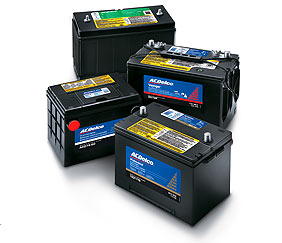
Twelve volts has been sufficient for the automobile industry for decades and the battery design has remained pretty much the same – lead acid. Yes, dear folks, there is both lead and acid in most car batteries. It is that chemical reaction between the two that releases the voltage our cars require to turn the engine over and fire the spark plugs. It was invented in 1859 by Gaston Plante, a French physicist.
But it doesn’t use just volts to turn over the starter. No, it also uses amps. That is why CCA (cold cranking amps) is an important consideration when picking a replacement for a worn out battery. It is a measurement of the amperage that the battery can supply for 30 seconds at zero degrees F. That is why most battery failures happen in the colder winter months. Cold weather reduces the battery’s output. And hot temperatures reduce a battery’s life. Which leads one to wonder why they are kept in the hot engine compartment.
It is important to understand a little about the chemistry used in the common lead acid battery. As electricity runs through the battery it causes the water inside the battery to change to its basic elements of oxygen and hydrogen. I hope you recognise those two elements and their explosive nature.
Battery Maintenance
Today batteries come in two basic types – sealed and unsealed. The sealed can be lead acid with the same distilled water mix as the unsealed or they might be the “gel” battery type where it is not only sealed, but there is a gel used instead of a liquid. The sealed gel batteries don’t need to be vented either. This can be a plus if you ever decide to move your battery from the engine compartment to the trunk.

Always take time to inspect the battery terminals. These are either on top of the battery or on the side. The top ones are posts about an inch in diameter where the cables are held with clamps. Side posts have threaded spots where the cables bolt up to. Notice that in both cases each terminal is far apart from each other. You never want to have anything that can conduct electricity touch the two terminals together. I’ve seen mechanics foolish enough to be wearing a metal watch band touch the positive terminal to the frame and weld themselves to the frame with the watch band. One very hot watch band.
Cleaning the battery can be a good thing if it is done the right way. First off you should disconnect the terminals starting with the negative side first. If the terminal has a red cover than it is NOT the negative. Once the battery is disconnected from the electrical system you can clean it carefully. You should be wearing safety glasses that shield your eyes from any possible splatter. Remember, there is acid in that battery. You should also be wearing latex or vinyl gloves to protect your skin.
These batteries weigh anywhere from 40 to 60 pounds. If you can manage that weight safely then remove the battery from the car. This will protect the car from any acid splatter that might occur accidentally.
Auto parts stores sell spray-on battery cleaners that make it easy to apply. Remove the excess cleaner and dirt with paper towels and dispose of them carefully. You can make your own cleaner with a mix of baking soda and water. The baking soda neutralizes the acid on the outside of the battery. Don’t get any on the inside of the battery.
The terminals and clamps should be brushed clean with a small wire brush being careful not to get any of it in your eyes. That is one of the reasons you are wearing safety glasses. Auto parts stores sell specially made brushes to clean the terminals and clamps too.
If it is a sealed battery that is as far as you go. But if your battery has caps covering the cells you can pull or unscrew them and check out the “water” level in each cell. Clean carefully any new dirt exposed from removing the covers being certain not to get dirt or cleaner into the cells.
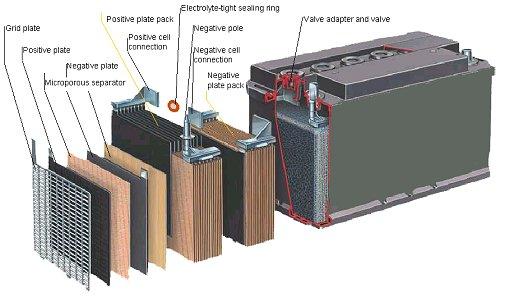
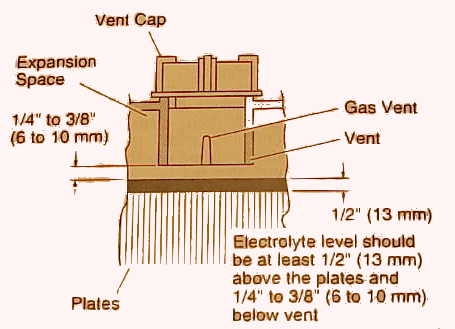
You should use a flash light to view inside each cell. NEVER use a match or flame! There is hydrogen gas released and batteries will explode. A battery explosion can not only damage your car it can kill or maim you while spreading acid over everything. A flash light is safe though. As you peer down each cell’s hole their should be “water” covering the lead plates. If the lead plates get exposed to air it is likely that you are going to be buying a new battery. You should add only DISTILLED water to a battery if the water is low. Tap water has too many contaminates to be used. You should only fill it so that the water acid mix come up to the bottom of the plastic tubes, never to the top of the hole. Any excess water should be captured with a paper towel. Then the caps need to be secured.
When attaching the cables back onto the battery be certain that the positive terminal goes on first. Make certain that you know which terminal is positive, too. It should be marked on the battery case itself. Attach the negative terminal last.
How long should your battery last?
That’s easy, it depends. Today’s cars ask a lot out of the 12 volt electrical systems and the battery, too. They need to run DVD players, GPS units, heated seats, heated cup holders, and hundreds of sensors, no to mention the engine, lights, radio, etc. As a result car batteries don’t always last for five years or more. With all the demands on them they are more likely to wear out in two or maybe three years.
Some cars do better than others. Subaru cars tend to be frugal with their power demands as are many Honda and Toyota cars. Cadillac, Chevrolet, Nissan and GMC models are are the opposite end of the demand scale.
Soon we may see the twelve volt system disappear and a new standard, the 42 volt system will become the standard. This will allow plenty of power for the miriad of devices that make up modern cars.


 JIM'S GARAGE
Leave a reply to milo Cancel reply