


This week we had a visit from a car that we had worked on some before. It is Ted’s 2006 Subaru Legacy GT SpecB. This is quite an interesting car from Subaru. It comes with a lot of luxury items like GPS, heated seats, and a nice sound system, but it also has a potent 2.5 liter turbo and the SpecB Bilstein suspension. It is a bit of a sleeper because it is a sedan that doesn’t throw out a lot of the styling cues that are normally used by car companies to announce that this car is special. The only way you would know that it is a SpecB is if you saw the plate on the center console that tells you it is 263 out of 500 made.
No it’s not a WRX STi, but it does have a lot more going for it than a “regular” Legacy GT.
It also has some bad manners. Ted originally brought it to me because he was disappointed in the handling. He felt that it had too much body roll and felt imprecise. Ted likes a car that feeds back to the driver and obviously the SpecB was letting him down.
I took it for a test drive and agreed with him that it had more body roll than it deserved and let Ted know that I felt we could improve things. Ted wanted to jump on some springs to lower the stance as the solution and I balked. It was not that I didn’t realize that the center of gravity would be lowered by this approach, but I was concerned that the roll center would likely be moved to below the ground level.
What the heck is the “roll center” you may well ask. It is a point on which the front suspension rotates the body as it takes a corner. Depending where it occurs – above ground or below ground – your handling can be worse even with a lowered center of gravity. In my youth I’ve enthusiastically found the springs that lowered my car the most and then had to live with bump steer and understeer that fought me as I tried to corner quickly. What I was fighting was the effect of moving the roll center below ground.
So the first thing I did to reduce the body roll was to get a larger adjustable anti-roll bar for the rear as well as more substantial end links to ensure that the bar could do its job without distorting the end links. Then I installed a front strut tower brace to crisp up the front geometry. Later I installed Goodridge braided stainless steel brake lines on all four corners.
Ted was delighted with the improvement to the car’s handling characteristics but still wondered if more could be done. I was reluctant to try springs until I could also solve the roll center issue.
Then some research pointed me to a kit that took care of the roll center problem. It was by Whiteline and consisted of new ball joints and tie rod ends. The ball joints were extended so that the lower control arm would be brought back to a proper angle and the tie rod ends did the same to ensure that bump steer was minimized.

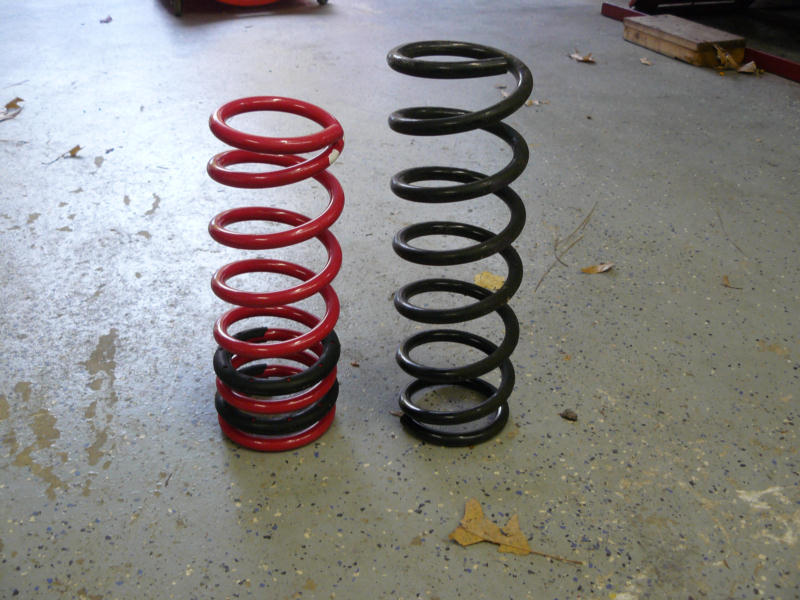
I let Ted know about the solution so we ordered a set of STi pink springs for the Legacy GT SpecB along with the roll center correction kit.
Getting the Subaru up in the air we removed the wheels and marked which corner they came from so they could be stacked out of the way. Then we started with the front struts. First we marked the position of the eccentric top bolt at the bottom of the strut mount with white out. Then we removed those bolts before undoing the three top nuts and lowering the assembly to the floor where we could work on it. With the spring compressor we took the tension off the assembly and used the air gun to remove the top nut off the Bilstein strut. The new pink springs were quite a bit shorter so they did not require quite as much compressing in order to assemble things.

The driver’s side was pretty much the same and with both strut assemblies back in place it was time to install the roll center kit. To do so require that the front anti-roll bar be removed at the brackets leaving the end links in place. That allowed the lower control arms to be levered down when it came time to remove the ball joints.

First I loosened the lock nuts on the tie rod ends and backed them off so I could mark the position of the end with white out. Then I unscrewed the tie rod end and screwed on the replacement. That part was pretty straight forward. The ball joint was held in by a cross bolt on the strut end and a castle nut and cotter pin on the control arm end. Both of those were easy to remove and then a shot of lubricant and a pry bar helped to separate everything. It helps that this is a low mileage car that is not driven in the northern climes.

The new ball joints are a bit taller and this is what corrects the angle of the control arm. I also had to move the hardened cone off the original ball joint and install it on the replacement. This is required because the control arm is an aluminum alloy and needs the protection of the hardened cone.

Then it was time for the rear shocks. First I had to remove the trunk trim on the bottom and both sides. The plastic push pins are far easier to deal with than what Mitsubishi uses in their trunk. All that was needed was a tool to pop them out. Over the spare tire is a tray that was a very handy place to store all these small fasteners.
With the trim panels out of the way I could reach the two nuts that hold the top of the rear shock in place, but first I had to undo the large bottom bolt and support the bottom of the shock with a floor jack. That kept it from crashing to the floor once I removed the top nuts. With everything undone I could lower the jack enough to slip out the shock assembly.
Once again, the new springs were considerably shorter than the originals which made installation with the spring compressor just as easy as with the front struts. Here are some shots of the springs prior to mounting.
With everything put back together and properly torqued it was time to think about alignment. No, I don’t have an alignment rack, but I do have a good buddy that has an excellent rack with the latest in computerized equipment. He also understands that factory specs are not always desirable.

I was able to get a slot in his schedule this morning and was pleasantly surprise at the starting point. The rear camber was a negative 1.0 degree on both sides and the front was a negative 0.6 degree on each of the front sides. The only thing that required adjustment was toe and we set that to zero for both the front and the rear. While the front struts to provide for camber adjustment there was no adjustment for caster, which was in the neighborhood of 6 for both sides. The rear has no adjustment for camber.
With all that done we did an oil change and made sure that the wheels were torqued to the factory specification of between 100-120 Nm.
The car now has plenty of roll stiffness without paying a penalty of an improper roll center. It handled beautifully providing plenty of feedback, yet with the Bilsteins, there was no penalty of harshness. The ride is excellent and I see no reason why Subaru could not have equipped the car like this from the get go. Ted is going to grin all the way home when he picks this up tomorrow.


 JIM'S GARAGE
Leave a reply to Tim Cancel reply