

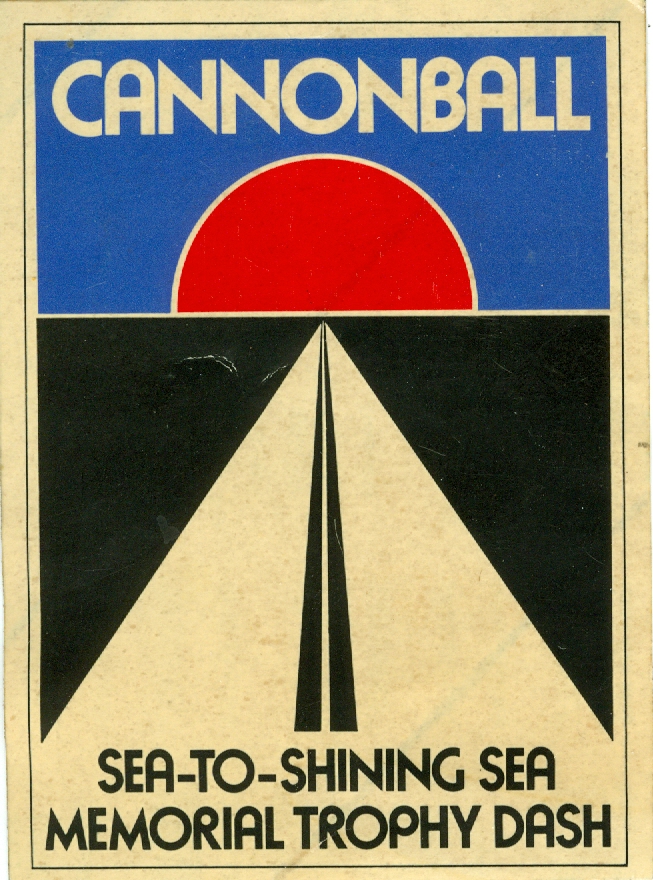
Forty years ago the US was deep into the Vietnam conflict with a great deal of protest from the public. The Woodstock music festival and the Kent State massacre were behind us and Watergate and a federal mandated 55 mph national speed limit was ahead.
Ralph Nader, a man who never was even licensed to drive an automobile, had whipped the public into a frenzy over the dangers of the automobile and driving in general.
In 1903 a doctor from Vermont had driven from San Francisco to New York City across country with virtually no paved roads and no highway system or gasoline stations in just over sixty-three days. In 1971 an irreverent band of automobile enthusiasts would travel the opposite direction to discover just how short of time a transcontinental automobile trip could take.
Steve Smith and Brock Yates had been kicking around the idea for a few years. Part of the inspiration for such an event was the exploits of Erwin George “Cannon Ball” Baker, who set many cross-country records in all kinds of motor vehicles in the first decades of the twentieth century.
The other inspiration came from a need to demonstrate to the rest of the world that America’s spirit of adventure was not dead. The movie Two Lane Blacktop had been released and following the first Cannonball came the movie Vanishing Point.
Early in 1971 Yates did a solo recon drive in a van christened Moon Trash II. The first Cannonball Sea to Shining Sea Memorial Trophy Dash that had multiple vehicles, the first competitive one, was held in mid-November of 1971. Non other than Dan Gurney and Brock Yates drove a new Daytona Ferrari from NYC to Long Beach in 35 hours and 54 minutes. Other than bragging rights, there was no prize or payment for coming in first. Dan observed that they had done so and had not bothered anyone. No one was run off the road or inconvenienced by the Ferrari’s rate of speed or the way it was driven. The only incident with the police was as they were approaching the California border and a trooper stepping out of restaurant about 100 yards from the highway heard them buzz by at about 110 mph. The highway patrol officer gave chase, at speed exceeding 140 mph and caught up with them as they stopped to fill their gas tank at a service station. If it was wrong for them to be traveling on an empty highway at 110 mph, why was it not dangerous for the trooper to be chasing after them at over 140 mph?
To this day Dan is probably more famous for his participation in the Cannonball than his driving in Formula One or Lemans.
I had been driving for only a couple of years when I read Brock Yates column on the trophy dash in May of 1972. I could hardly contain my elation. They were American heroes.
The Interstate highway system was not quite complete back then and gasoline was selling for about twenty-five cents a gallon. It would be a couple of more years before conflict in the mid-east and OPEC would change prices and Nixon would depart the White House leaving a parting gift of a national speed limit.
The amount of cars on the Interstates was also considerably less than we deal with today and the roadways were still fairly new.
Back in the late nineties I once traveled the 800 miles from Cape Cod to my home in NC in ten and a half hours. I had left very early in the morning and lucked out by tucking in behind the Governor of Rhode Island’s limo just as I hit Providence, RI. With a RI state trooper driving ahead of me I made fantastic time through RI and half of CT. If I had been able to drive coast to coast at that rate I could have done the Cannonball in 36 hours. But times have changed. The roads are now jam packed and speed enforcement consists of multiple and varied electronic devices. Gasoline costs nearly four dollars a gallon. To try and replicate such an event today would be a disaster.
The Cannonball should be remembered, though. It was a very bright light at a time when there were not many bright lights. It gave young car enthusiasts hope for a driving future that we would never really see.


 JIM'S GARAGE
Leave a reply to Mark Cancel reply