

This weekend’s work on the Miata really was a milestone for the project.
Last weekend Doug lent a hand and changed out the timing belt and the water pump. Two very important components on this car with over 150,000 miles on the odometer.
With no service records to go by it was a “no brainer” to perform these replacements. This car will be seeing some extreme demands on the track and autocross circuit this year and that makes maintenance tops on the priority list.
Replacing the timing belt ensures that the belt won’t snap or even skip a couple of teeth. This is an interference engine, which means that a timing belt failure would cause a great deal of damage to the valves and drivetrain.
Doug is the guy I trust most for this kind of precision work. We had drained the coolant from the engine quite a while ago so he was free to get the drive belts removed and all the covers off the block.

The old timing belt stayed on long enough for Doug to position the number one piston at top dead center (TDC) and then remove the tensioner and idler pulleys. Then the cam gears could be unbolted and removed so that the cam journals holding the cam seals could also be removed. The cam seals were being replaced with new ones.

The waterpump was removed and the surfaces were cleaned up in preparation for the new water pump and other replacement items.

The new waterpump was installed and the fasteners were all tightened to their proper torque values.

On went the new Gates Racing version of the timing belt along with new tensioner pulley, spring, and idler pulley. The new cam seals and original cam gears were installed in preparation. The tension was set and the timing was checked. Everything was perfect.

While the crank pulley had been off Doug removed the old front crank seal and installed a new replacement. That was the last of all the seals that were replaced from the rear differential to the engine crank. There should be no leaks from this engine.
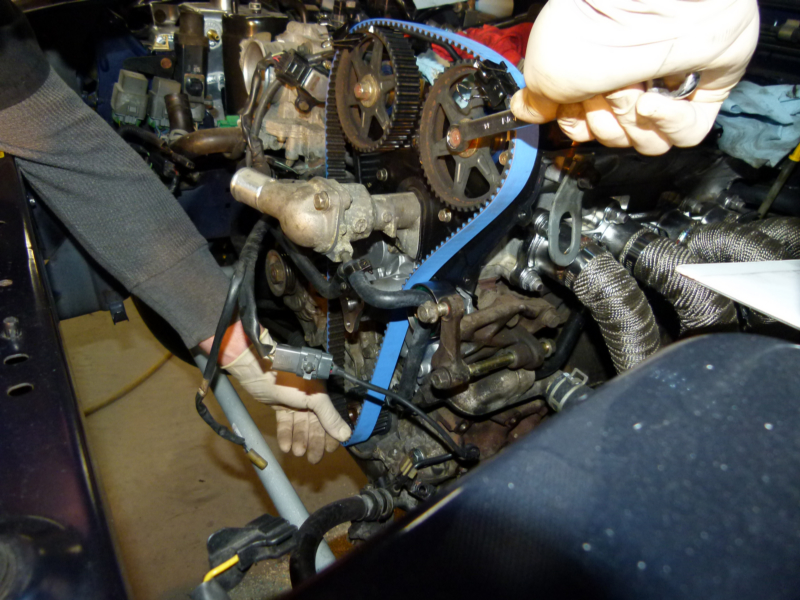
With the covers back on Doug put all new drive belts on. With the air conditioning removed we only needed a belt for the alternator and the power steering pump.

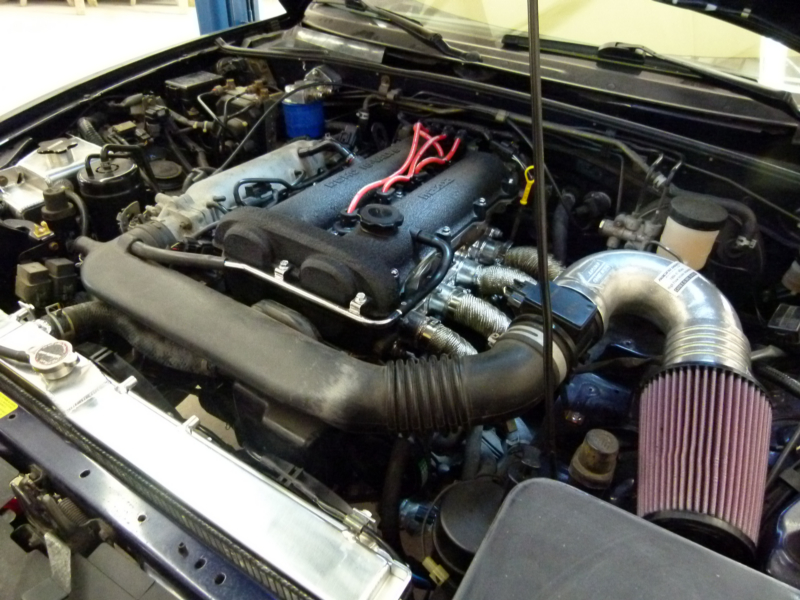
The new wrinkle-painted valve cover went on along with a new gasket. The engine was almost ready.
This weekend Doug was back and working to get the cooling system back in service.
I had a new all-aluminum radiator and a set of two new fans in a beautiful aluminum fan shroud mounted on the new radiator. Doug checked the draw of the two fans on the stock wiring and found they were well within the limits of the fan circuit. He grafted on the wiring connector from the original fan and then carefully routed the wiring harness after completely sealing it with shrink tubing. Doug is thorough.
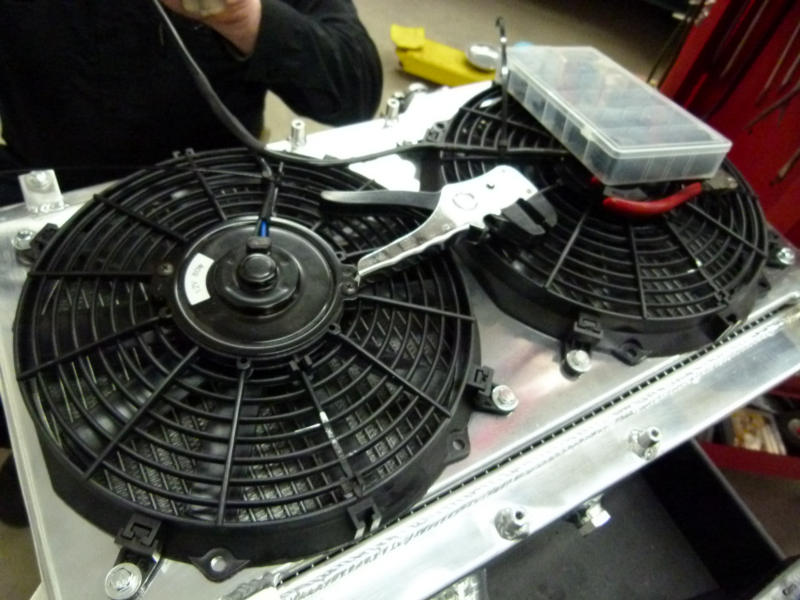
The fan and radiator assembly slipped right in with just some minor adjustments and then the coolant hoses were connected up. That included the new Moroso overflow tank.

With everything checked we added coolant to the system. The tool of choice was a vacuum tool that attached to where the radiator cap goes on and, using the shop compressed air, a vacuum was pulled on the system. This makes certain that there are no leaks in the system and prepares for the introduction of coolant.
We used a 50/50 pre-mix from Auto Zone. Once a vacuum is established a hose is connected to the gallon jug of coolant and the vacuum pulls the new fluid into the cooling system without introducing any air along with it. It took just about two gallons to fill the system.

It was time to fire up the engine for the first time in months.
It now had a new timing belt and waterpump, newly refurbished fuel injectors, and new crank and cam seals.
The battery was connected and the engine cranked over. After a while the engine finally started. It took a while to warm up and Doug noticed that the drive belt needed to be tightened so we shut it off so he could get that adjusted. Then we ran it again, letting it heat up fully.
It took a while, but finally it was hot enough for the fans to come on. Doug made sure that they were spinning in the correct direction and we let the engine run for a bit longer.
After all that break-in time we shut it off and pulled the spark plugs and drained the oil. A new oil filter was installed along with Castrol Synthetic’s Titanium oil in 10W-30. A new ball valve was installed to replace the factory oil pan plug.

Here is a close-up of the new ball valve oil drain:

The engine was started one more time to check the oil level and then a compression check was done. All four cylinders were 215-220 psi. That’s pretty impressive for any Miata engine, let alone one run for over 150K miles.
New NGK iridium spark plugs and Magnacore wires were installed. Now the motor just purred.


 JIM'S GARAGE
Leave a reply to Josh Cancel reply